Recovering from the Horn Effect: How to Rebuild Momentum and Confidence

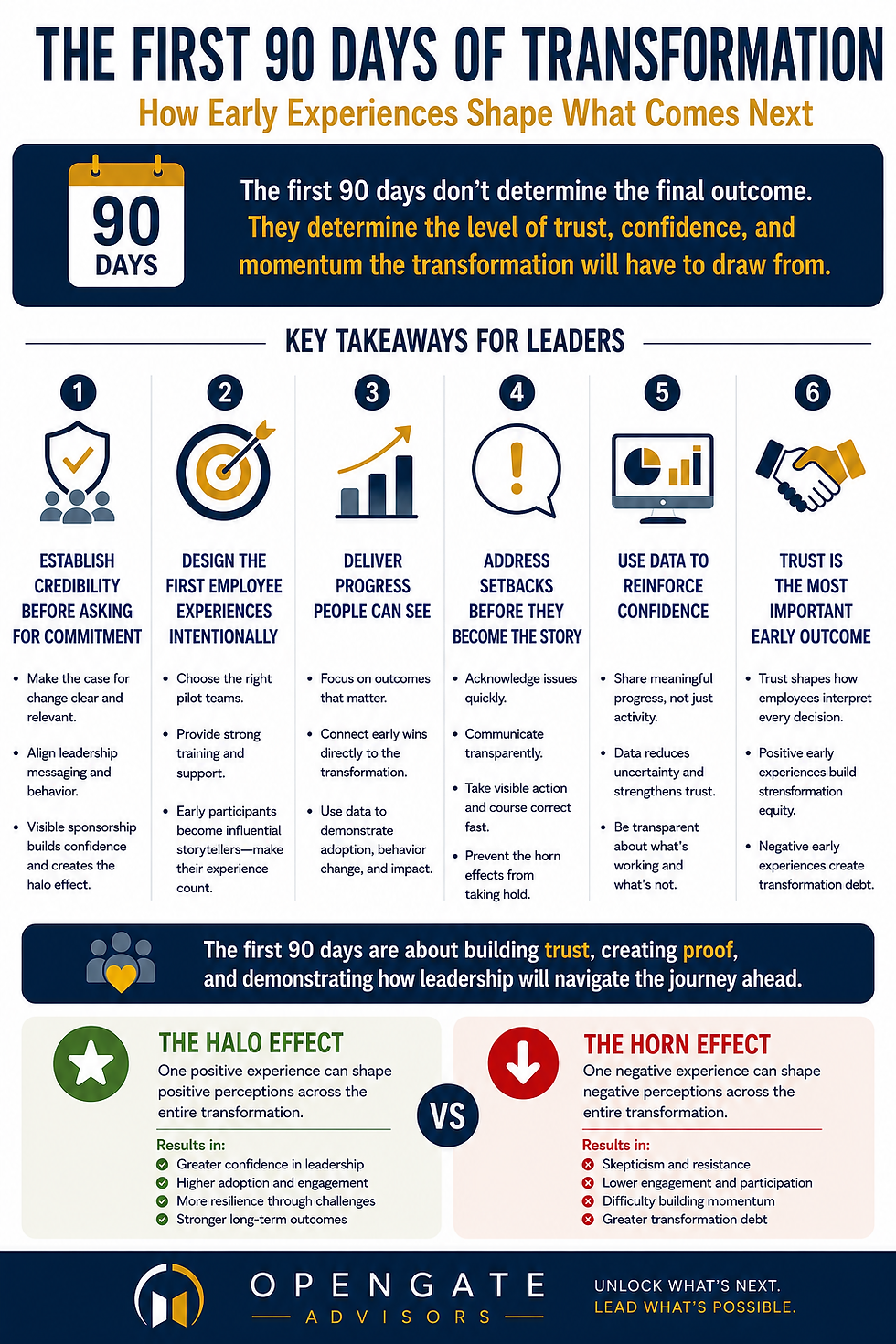
In the previous article, we explored how the Halo Effect and Horn Effect shape the way employees experience transformation. Once people conclude that an initiative is succeeding, they tend to interpret new developments as evidence that reinforces that belief. Conversely, once they conclude that a transformation is failing, every setback, missed commitment, or difficult decision becomes additional proof that they were right all along.
That is what makes the Horn Effect so dangerous. It changes the lens through which people interpret everything that follows. The encouraging news is that the Horn Effect is not permanent. Organizations recover from difficult transformations every day. The difference is that successful leaders recognize that once confidence has been lost, they are no longer simply managing a transformation. They are rebuilding organizational belief.
Recovering from the Horn Effect is ultimately about replacing skepticism with evidence. Every leadership decision should help employees answer one question:
"Why should I believe this transformation will succeed?"
The answer is built through repeated proof rather than persuasive messaging.

Diagnose What People No Longer Believe
One of the biggest mistakes leaders make is assuming they know why confidence has declined. Sometimes employees have stopped believing in the strategy itself. More often, they still believe the destination is the right one but have lost confidence in leadership's ability to execute the journey.
Those are fundamentally different problems. Before introducing new initiatives or communication plans, leaders must first understand what confidence has actually been lost because the answer determines what must be rebuilt first. A recovery plan that addresses the wrong problem simply reinforces the perception that leadership is out of touch.
Replace Explanation With Demonstration
When a transformation begins to struggle, organizations often default to explaining why previous decisions made sense at the time. They defend timelines, rationalize tradeoffs, and remind employees why difficult choices were necessary. While context has value, explanations rarely restore credibility.
Employees are generally less interested in why something failed than they are in whether leadership learned from it. Leaders earn trust when they can acknowledge reality without becoming defensive. Saying, "This approach did not produce the results we expected. Here's what we learned, here's what we're changing, and here's how you'll know whether it's working," communicates adaptability rather than weakness. Leaders who recover quickly are rarely those who avoid mistakes. They are the ones who demonstrate an ability to learn faster than the problems emerge.
Ruthlessly Prioritize What Matters Most
One of the most common reactions to a struggling transformation is to accelerate activity. New workstreams are launched, governance meetings multiply, and additional initiatives are introduced in an effort to regain momentum. Unfortunately, increased activity is often mistaken for increased progress.
Organizations experiencing the Horn Effect need the opposite approach. They need ruthless prioritization. Leadership must become disciplined about protecting organizational capacity by asking whether every initiative meaningfully advances the transformation's most important outcomes. If it does not, it should be paused, delayed, or eliminated.
Pause initiatives that are valuable but do not need to happen right now. These efforts remain important, but they temporarily give way to work that is more critical to restoring momentum and confidence.
Delay initiatives that depend on capabilities, decisions, or resources that are not yet in place. Rather than forcing work to move forward prematurely, establish clear conditions for when it should resume.
Eliminate initiatives that no longer align with the transformation strategy or whose expected value no longer justifies the investment. Recovery often requires acknowledging that some work should not be restarted at all.
Making these distinctions helps leaders avoid treating every initiative as equally important. It also signals to the organization that leadership is making deliberate choices rather than simply asking people to do more with the same finite capacity.
One of the clearest tests of executive leadership is whether they are willing to say no to good ideas so the organization can successfully execute the few priorities that matter most. When people begin seeing consistent progress against a focused set of priorities, confidence gradually returns because execution once again becomes reliable.
Create Wins That People Can Experience
Large transformations often promise benefits that may not materialize for months or even years. While those long-term outcomes matter, but confidence is rebuilt through experiences that employees can see and feel today.
That means intentionally identifying opportunities to deliver improvements that are highly visible, broadly experienced, and directly connected to everyday work. A process that becomes simpler, a tool that saves meaningful time, or a decision that removes unnecessary complexity often does more to rebuild confidence than another presentation describing the future vision.
Momentum has a compounding effect. Every meaningful success weakens the Horn Effect because it introduces evidence that no longer fits the existing narrative. Eventually, employees stop asking whether the transformation is failing and begin recognizing that it is making a positive difference.
Make Progress Visible Through Data
Executives experience transformation through dashboards. Employees experience it through their daily work. If they cannot see progress, they often assume none exists. Data therefore becomes far more than a governance tool. It becomes a mechanism for rebuilding confidence.
The most effective organizations identify a small set of meaningful metrics that demonstrate outcomes employees actually care about, such as:
Customer onboarding has become faster
Adoption has increased
Manual work has decreased
Decision-making has become more efficient.
Those outcomes provide objective evidence that the transformation is delivering value.
The same metrics also reinforce accountability. Every strategic priority should have a clear owner, measurable outcomes, and a regular cadence for reviewing progress. Accountability is not about assigning blame after something goes wrong. It is about creating visibility early enough to remove obstacles, make informed decisions, and maintain momentum before small issues become larger setbacks. When people can see measurable progress and understand who is accountable for delivering it, confidence becomes grounded in evidence rather than opinions.
Recovery Is About Rebuilding Trust
Perhaps the greatest danger of the Horn Effect is not that people lose confidence in a particular transformation. It is that they begin losing confidence in the organization's ability to successfully change. The conversation quietly shifts from "This project is struggling" to "Nothing ever works around here."
That transition creates transformation debt that extends well beyond a single initiative. Every future transformation begins with greater skepticism, lower engagement, and less willingness to believe leadership's commitments. Recovering from the Horn Effect therefore requires more than improving project execution. It requires rebuilding trust in the organization's ability to deliver meaningful change. That trust is earned through disciplined execution, ruthless prioritization, transparent accountability, and visible progress that employees experience consistently over time.
Leaders cannot talk their way out of the Horn Effect. Confidence is earned through repeated proof, not persuasive messaging. Every fulfilled commitment, every meaningful outcome, and every visible win begins to replace skepticism with confidence until the evidence becomes impossible to ignore.
Comments