Lasting Impressions: The First 90 Days of Transformation
- Ashley Gatewood
- Jul 1
- 4 min read

Transformation may take years to complete, but employees often decide within the first few months whether they believe in it. Before the organization has enough evidence to judge the full strategy, people begin forming conclusions based on leadership behavior, communication, and their earliest experiences with the change. The halo and horn effects help explain why those initial impressions carry so much weight.
Psychologist Edward Thorndike introduced the halo effect through research showing that one favorable characteristic can influence how people assess other, unrelated qualities. Later research found that an overall impression can shape how individuals interpret specific information, even when they believe they are evaluating it objectively (Thorndike, 1920; Nisbett & Wilson, 1977).
In a transformation, one positive experience can create confidence in the broader effort. A credible sponsor, a well-supported pilot, or a visible improvement may lead employees to assume the transformation is thoughtful, organized, and likely to succeed.
The horn effect works in the opposite direction. A confusing announcement, poorly managed launch, or obvious disagreement among leaders can cause employees to question the entire initiative. Negative experiences may be especially influential because people generally give greater weight to unfavorable information than equally strong positive information (Baumeister et al., 2001).
The first 90 days therefore represent more than the beginning of implementation; they establish the lens through which employees will interpret what follows.
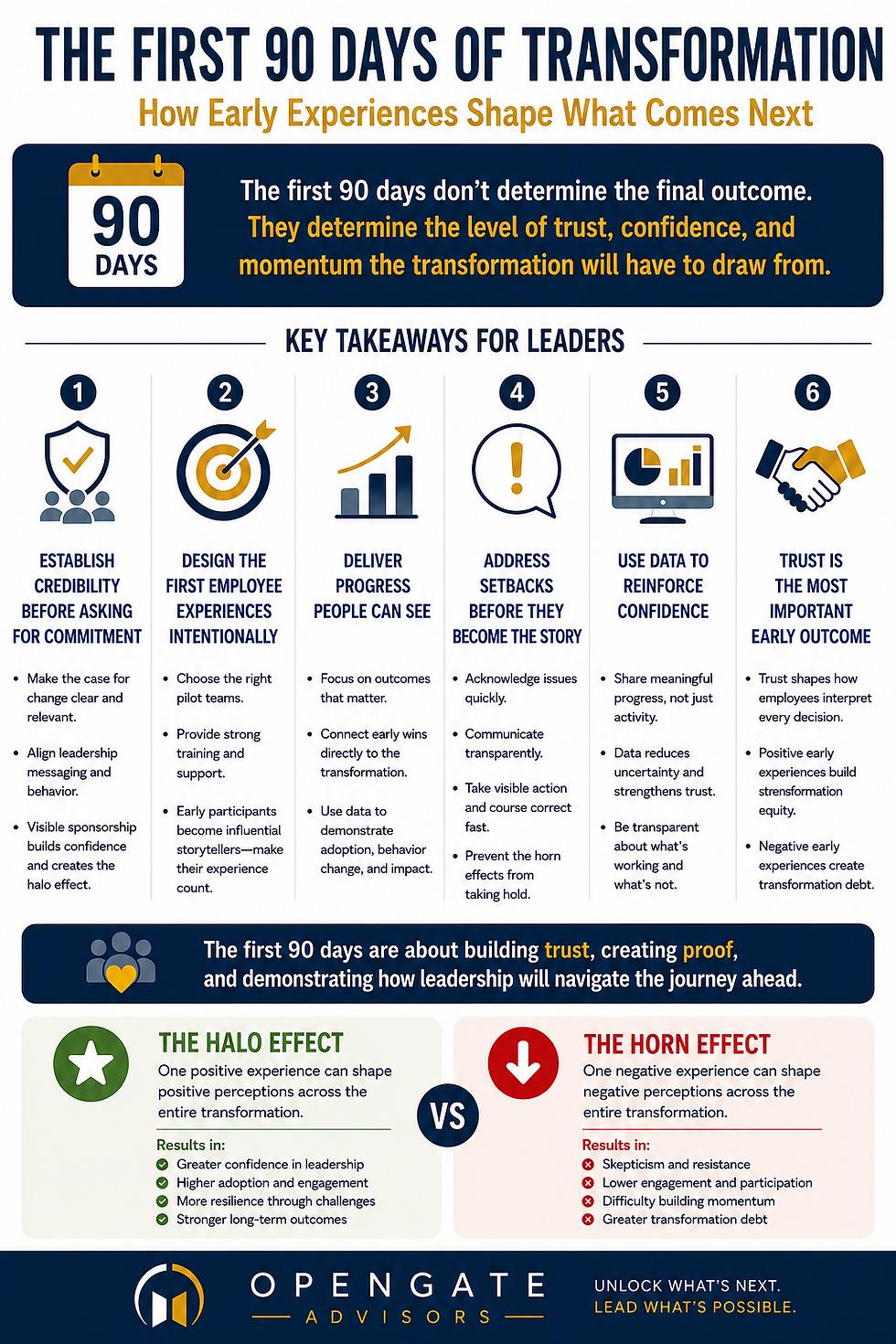
Learn more about each takeaway below!
Establish Credibility Before Asking for Commitment
Employees are more likely to support change when leaders provide a clear and credible explanation of why it is necessary. That explanation should connect the transformation to real business conditions, customer needs, workforce challenges, or strategic opportunities rather than relying on generic messages about innovation or growth.
Leadership alignment matters just as much as the message itself. Employees notice when executives describe the transformation differently, continue prioritizing work that supposedly no longer matters, or delegate visible sponsorship to the change team. These inconsistencies can create a horn effect before implementation has meaningfully begun. Leaders should align on the case for change, the decisions that have already been made, the questions that remain open, and the behaviors they will personally model. Credibility grows when communication and leadership behavior reinforce each other.
Design the First Employee Experiences Intentionally
The earliest pilots and rollouts become evidence employees use to judge the larger transformation. Choosing a first wave solely because it is available, highly visible, or facing the greatest performance challenges can introduce unnecessary risk. Early pilots and team members should be selected with enough complexity to generate meaningful learning, but enough leadership stability and capacity to succeed. They also need strong training, responsive support, and clear ways to escalate problems.
This does not mean hiding challenges or creating an artificially perfect experience. It means recognizing that the first participants will become informal storytellers. Their experience will often travel farther and faster than the official communication campaign.
Deliver Progress People Can See
John Kotter’s research on organizational change emphasizes the role of short-term wins in demonstrating that sacrifice is worthwhile, rewarding those supporting the effort, and building credibility for the broader change (Kotter, 1996). However, not every completed activity qualifies as a meaningful win. Launching a governance committee, publishing a roadmap, or completing training may show movement, but employees are more persuaded by changes they can see or feel.
An effective early win might reduce approval time, eliminate duplicate work, resolve a persistent customer problem, or help employees make decisions more quickly. The result should be measurable, connected to the transformation, and important enough to matter to the people affected.
Leaders should also use data to show whether adoption is increasing, behaviors are changing, and business outcomes are improving. Data should support accountability and learning, not become a polished collection of favorable metrics. When results fall short, leaders should explain what the organization has learned and what will change next.
Address Setbacks Before They Become the Story
Every major transformation will encounter problems. Employees do not expect flawless execution, but they do pay close attention to how leaders respond when something goes wrong.
Silence allows people to fill gaps with assumptions. Defensive communication suggests that leaders care more about protecting the initiative than improving it. Delayed action can turn a contained issue into evidence that the entire transformation is poorly managed. Leaders should acknowledge setbacks quickly, clarify their impact, identify who is accountable for resolving them, and communicate what will happen next. Visible course correction can limit the horn effect because it gives employees a different conclusion to draw: the transformation may be difficult, but leadership is listening and capable of responding.
Trust Is the Most Important Early Outcome
Organizations often evaluate the first 90 days through implementation milestones, training completion, system readiness, or budget performance. Those measures matter, but the most consequential early outcome is trust. When leaders communicate clearly, align their behavior, deliver visible progress, and respond honestly to setbacks, they strengthen employees’ confidence in the transformation. That confidence creates a positive lens through which future challenges are interpreted.
When the first 90 days are defined by confusion, inconsistency, or unaddressed disruption, skepticism begins to compound. Even sound decisions may be interpreted negatively because employees no longer evaluate each action on its own merits.
The halo and horn effects do not mean leaders should manufacture optimism or attempt to manage perception without improving execution. They reveal that perception and execution cannot be separated. Every early decision becomes part of the organization’s evidence about whether leadership can be trusted to guide the change. Transformation leaders should therefore treat the first 90 days as an opportunity to establish credibility, create meaningful proof, and demonstrate how the organization will respond when the path becomes difficult. The impressions formed during that period will not determine every outcome, but they will shape how much trust, participation, and resilience the transformation can draw upon in the months ahead.
References
Baumeister, R. F., Bratslavsky, E., Finkenauer, C., & Vohs, K. D. (2001). “Bad Is Stronger Than Good.” Review of General Psychology, 5(4), 323–370.
Kotter, J. P. (1996). Leading Change. Harvard Business School Press.
Nisbett, R. E., & Wilson, T. D. (1977). “The Halo Effect: Evidence for Unconscious Alteration of Judgments.” Journal of Personality and Social Psychology, 35(4), 250–256.
Thorndike, E. L. (1920). “A Constant Error in Psychological Ratings.” Journal of Applied Psychology, 4(1), 25–29.


Comments